Mumbai, India+91-8967667496connect@kannamwar.comAvailable for global projectsLinkedIn ↗
Kannamwar EngineeringStart a Project

Service

Sea Fastening & Load-out Engineering

Sea-fastening and load-out engineering for cargo, modules and cranes carried on barges and heavy-transport vessels: motion and acceleration criteria, grillage and tie-down design, ballast and load-out sequences, and the calculation package prepared for marine warranty surveyor approval. Delivered from Mumbai to EPC, T&I and fabrication contractors in India, the Gulf, West Africa and Southeast Asia.

Sea Fastening & Load-out Engineering

What you receive

  • Transportation motion analysis (MOSES / OrcaFlex) with DNV-ST-N001 or client-specified default motion criteria
  • Sea-fastening design: stoppers, braces, lashings, clips and welds with weld-capacity checks
  • Grillage and deck-strength verification against barge or vessel structure
  • Skidded, trailer (SPMT) and lifted load-out analysis with ballast sequence and stability at each step
  • Stability and longitudinal strength checks for the loaded barge (GHS / Maxsurf)
  • Method statement inputs, drawings and the calculation note formatted for MWS review comments

What the package covers

A sea-fastening and load-out package starts from the cargo data (weight, centre of gravity, footprint, lift and skid points), the transport vessel data and the route, and ends with a set of drawings and calculations a marine warranty surveyor can approve without a second round.

We run the transportation analysis first, because the motion criteria decide everything downstream. For open-sea tows we apply DNV-ST-N001 default motions unless a route-specific study is available; for benign or sheltered routes we agree reduced criteria with the MWS before design starts. Sea-fastening members, welds and grillage are then sized to those loads, and the barge deck and internals are checked for the local reactions.

Load-out analysis follows the same logic step by step: skid or SPMT reactions, barge ballasting to hold the link-beam or ramp within tolerance across the tide, longitudinal strength of the barge at every stage, and intact stability throughout.

Codes and criteria we work to

  • DNV-ST-N001 Marine Operations and Marine Warranty (transport, load-out and sea-fastening chapters)
  • ISO 19901-6 Marine operations
  • Noble Denton / GL Noble Denton 0030 legacy guidelines where the client or MWS specifies them
  • AISC / API RP 2A for structural member and weld checks; classification-society rules for the barge structure
  • Client and MWS-specific motion criteria, which we document and agree before design

Prepared for marine warranty approval

We do not act as the marine warranty surveyor; the MWS must be independent of the designer. What we deliver is the engineering the MWS reviews: a calculation note that states the criteria, the load cases and the utilisations clearly, drawings that match the calculations, and a response sheet for review comments. Packages we have prepared this way have supported crane-on-barge sea-fastening, riser and conductor installation campaigns for ONGC, and vessel deck-equipment installations in Nigeria.

Who buys this and how it is scoped

Typical clients are EPC and T&I contractors, fabrication yards, barge and heavy-transport operators and owners moving a single heavy item. A scope is usually fixed-fee per cargo or per voyage, with a proposal issued within five working days of receiving the cargo and vessel data. Time-zone overlap from Mumbai covers Gulf and European working hours on the same day.

Codes & standards

DNV-ST-N001ISO 19901-6API RP 2AAISC 360IMO IS Code

Software

MOSESOrcaFlexGHSMaxsurfSACSSTAAD.Pro

Cargo & vessels

ModulesJacketsCranesRisers & conductorsBargesHTVsDeck cargo

Ready to Start Your Next Project?

Let's discuss how our engineering expertise can bring your vision to life — from concept to commissioning.

Projects that prove it

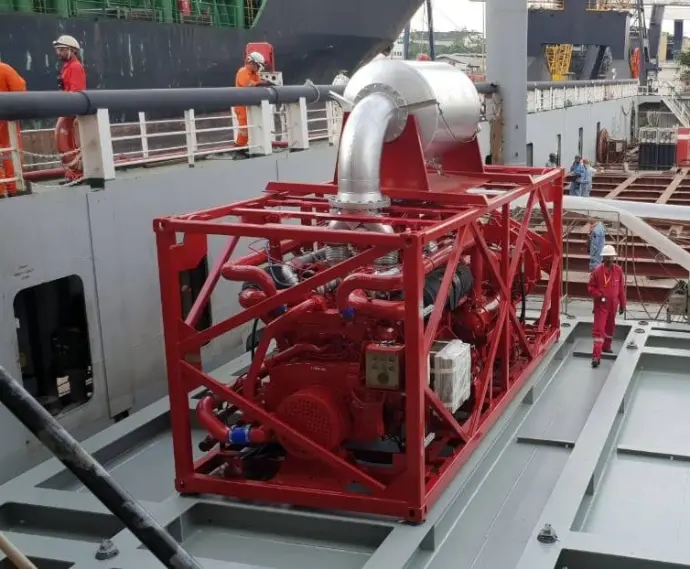
Sea-fastening & load-out — crane on bargeSea-fastening design and load-out engineering for crane transportation on barge — 6 items secured for safe passage.Riser installation — 4 platforms, 16 liftsCrane vessel installation engineering for risers across 4 offshore platforms — vessel selection, installation analysis, and methodology for 16 lifts.Davit installation — 4 × 50 MT davitsStructural engineering for the installation of four 50 MT davits along the port side of an offshore construction vessel.

Related services

Lifting & Heavy-Lift EngineeringLift engineering for offshore and yard lifts: rigging design, lift-point and padeye checks, dynamic amplification, crane-vessel and barge stability during the lift, and the lift plan calculations reviewed by class or a marine warranty surveyor. Our team has engineered 100+ heavy lifts, including riser and conductor installation campaigns on ONGC platforms.Transportation & Installation (T&I) EngineeringTransportation and installation engineering for jackets, topsides, modules, risers and conductors: load-out, transportation, launch or lift, upending, set-down and hook-up analysed as one sequence, with the method statements and calculation notes the marine warranty surveyor reviews. Delivered for ONGC riser and conductor installation campaigns and vessel-based installations in Nigeria.Third-Party Verification & Independent Design ReviewIndependent verification of offshore structural, naval architecture and pipeline engineering: design reviews, re-analysis with our own models, structural integrity assessments and owner’s-engineer review of contractor deliverables. Our team has reviewed five jackets and topsides for an operator and assessed 39 ONGC jacket structures, and supports jack-up site assessments in ONGC, ADNOC and Aramco fields.

Regions we serve for this

Offshore, Marine & Pipeline Engineering in IndiaKannamwar Engineering is headquartered in Mumbai and delivers offshore structural, naval architecture and pipeline engineering to operators, EPC contractors and yards across India: ONGC’s western offshore fields, HPCL’s marine terminals, west-coast LNG infrastructure and the east-coast basins. 39 ONGC jacket structures assessed, riser and conductor installation campaigns engineered, and 120+ days of offshore site supervision at Mumbai High.Offshore Engineering Support for the Gulf: UAE, Saudi Arabia, Qatar, Oman, KuwaitEngineering support for EPC, T&I and fabrication contractors and jack-up operators working in the Arabian Gulf: jacket and topside engineering, sea-fastening and load-out packages, lifting engineering, jack-up site-specific assessment support and third-party design review, delivered from Mumbai in the same working day. Saudi Aramco and Lamprell are among our clients.Offshore & Marine Engineering Support for Nigeria and West AfricaEngineering support for vessel owners, installation contractors and terminal developers in Nigeria, Ghana, Angola and the wider Gulf of Guinea: vessel upgrades and deck-equipment installation, pipe-lay and installation engineering, class approval packages and design review. Our team has delivered a pipe-lay vessel piggyback pipeline upgrade and a four-davit installation on vessels operating in Nigeria.

Sectors

Offshore Oil & GasMarine, Vessels & Conversions

Disciplines

Offshore Structural EngineeringNaval Architecture

Further reading

Stability Analysis for Offshore Vessels — The FundamentalsIntact and damage stability essentials every offshore vessel must satisfy.

Frequently asked questions

Do you provide marine warranty survey (MWS) services?

No. The MWS must be independent of the designer. We prepare the sea-fastening, load-out and transportation engineering that the MWS reviews and approves, and we handle their review comments.

Which motion criteria do you use for sea-fastening design?

DNV-ST-N001 default motions unless a route-specific motion study or reduced criteria are agreed with the marine warranty surveyor in writing before design starts.

How quickly can you turn around a sea-fastening package?

Once cargo data, vessel data and the route are received we issue a proposal within five working days; a single-cargo package is typically delivered in one to three weeks depending on MWS review cycles.

Can you check the barge itself, not only the sea fastenings?

Yes. Grillage, deck plating and internals are checked for local reactions, and barge longitudinal strength and intact stability are verified at every load-out and transport stage.